
How to grow your podcast audience with SEO and expert content so people find you on Google and AI
Help more people discover and listen to your podcast through Google, searchable episode pages and properly edited transcripts.
In this guide:
- The problem of podcast discovery
- People use Google to find podcasts
- Why podcasts need written content
- Why your podcast needs its own website
- How to find out what potential listeners are searching for
- How to transcribe your podcast and create a searchable episode page
- Use your podcast show notes to link back to the episode page
- Summary
1. The problem of podcast discovery
Why is it so hard to get people to listen to my podcast? I get asked this a lot.
Maybe you have published a few episodes, shared them on social media, told your friends, added the show to the main podcast apps and still feel as though you are shouting into a very well-upholstered void.
If that sounds familiar, you are not alone.
Making a good podcast does not automatically mean people will find it. That is one of the most frustrating parts of podcasting. You can put time, money and thought into the recording, editing, guest booking and production, then publish the episode and watch it disappear into a very crowded world of audio, video, newsletters, YouTube channels, social feeds and competing podcasts.
This is often where podcasters start to lose heart. Low listener numbers can be disheartening, especially when you know the show is useful, interesting or entertaining. The problem is often not the quality of the podcast, it's discovery.
People can't listen to an episode they never find.
One of the successful podcasts I produce is called My Garden Podcast. Gardening may not be your thing, but it is a useful example because it shows the problem clearly.
Someone might be looking for advice about growing tomatoes, planting carrots or looking after blueberries. They may not know the name of the podcast. They may not even know they want a podcast yet. They are simply looking for help.
That is where podcast discovery gets interesting.
The job is not only to tell people your podcast exists. The job is to make sure useful episodes can be found by people who are already searching Google for the subject you are discussing.
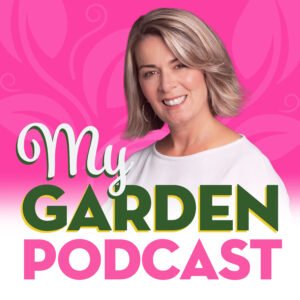
My Garden Podcast - Hosted by Penny Haslam
Podcast players are not your friends (in my opinion!)
Podcast apps are useful. They distribute your show, help existing listeners subscribe and make it easy for people to listen on the move.
But I would not rely on them to grow your audience.
All podcast players, including Spotify and Apple Podcasts, have their own search results, recommendations and algorithms. That can be helpful if you already have momentum, a recognised name or a large audience. It is less helpful if you are a smaller, independent podcaster trying to reach someone new.
The apps are not built around your listener journey. They are built around their platform.
That means you have limited control over how your show appears, what people see next, how much supporting information you can provide and whether a potential listener ends up listening to your episode or wandering off to something else.
This is not me saying podcast apps are bad. You still want your show available where people prefer to listen. But if your main discovery plan is to wait for Spotify, Apple Podcasts or another app to recommend you to the right person at the right moment, you are putting a lot of faith in someone else's machine.
And someone else's machine rarely cares about your lovely niche podcast as much as you do.
The problem with promoting your podcast on social media
Social media seems like the obvious choice for podcast promotion. Post about the episode, share a clip, add a graphic, tag the guest and hope people click.
There is nothing wrong with that. Social media can help people recognise your name, see what you are making and remember that your show exists.
But think about how you use social media. Are you usually there because you are trying to find a new podcast to listen to?
Probably not.
Most people are scrolling, half-watching a video, checking what friends are doing, avoiding work for five minutes or getting annoyed by someone they should really mute. They may enjoy your post. They may even like it. But that does not mean they are ready to stop what they are doing and listen to a 35-minute episode.
That is the difference between promotion and discovery.
Promotion tells people your podcast exists. Search helps you reach someone who is already looking for something specific.
If someone searches Google for a podcast about growing tomatoes, or for advice that your tomato episode answers, they are in a very different frame of mind from someone casually scrolling past a social post. They have a problem, question or interest right now.
This is where your podcast website, episode pages and transcripts can do much more of the heavy lifting than another social post.
The central idea is simple: do not rely entirely on podcast apps and social media to find listeners. Turn every episode into useful, searchable web content that reaches people already looking for that subject.

I help knowledge-based businesses and organisations get strategic about their content, so their ideas are clearer, visible and more likely to generate the right enquiries.
Book a no-obligation discovery call
Read next!

How to gather client testimonials that prove ROI and commercial value
Aug / 2026
Are meet the team pages pointless? I’d rather meet their expertise
Jul / 2026
Why doesn’t my consultancy website generate business leads? 10 common mistakes
Jul / 2026How to grow your podcast audience with SEO and expert content so people find you on Google and AI
Jul / 2026
How do I stop guessing what to blog about and choose topics based on customer intent?
May / 2026
Why do potential customers read my blog but not contact me?
May / 2026
Should I use Substack for my business blog? Why it might not be the right solution if you are seeking higher value leads and conversations
May / 2026
Why will social proof like testimonials, case studies and awards help drive more leads and enquiries to my business?
May / 2026
What are long-tail SEO keywords and how can a knowledge-based business use them to attract better leads?
May / 2026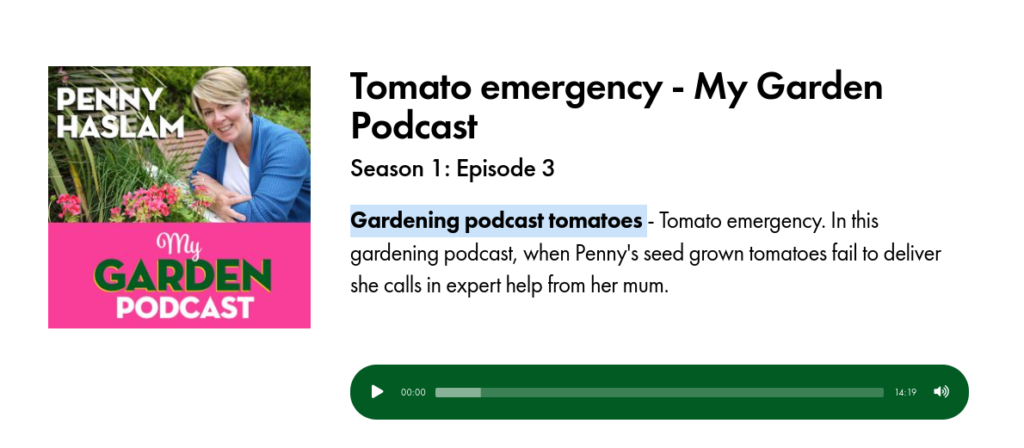
2. People use Google to find podcasts
Reach people who want to listen right now
There is lots of advice online about growing a podcast.
You will see tips about building a following, telling your friends, making sure your show is on all the podcast apps and posting about every episode on social media.
Some of that advice is useful.
But if you want to build an audience, you need to reach people who want to listen right now, with their phone and headphones at the ready.
Someone who sees your social post may be interested in your podcast. They may even think, “That sounds good, I’ll listen later.” We all know what usually happens to “later”. It quietly walks into the long grass and is never seen again.
Someone searching Google is different. They are actively looking for something. They may be looking for a podcast, a recommendation, a solution, an answer or a specific topic.
If your episode page can appear at that moment, you have a much better chance of turning a searcher into a listener.
That is the real opportunity.
Google is not only a place where people search for articles, products and local businesses. It is also a place where people look for solutions in the things they watch, read and listen to. Some will search directly for a podcast. Others will search for the subject your podcast covers.
Remember, you don't need every person on the internet. You need the right person at the right moment.
Let's look at some stats for people using Google to find podcasts. Here's a table of some real example search terms plus estmated monthly volume:
Search term - Monthly Searches (global)
- Funny podcasts - 10k-100k
- Best comedy podcasts on Spotify - 1k-100k
- Gardening podcast - 100-1k
- Yoga podcast - 1k-10k
- Dog training podcast - 100-1k
- Best football podcast - 10k-100k
Interestingly, around 100 thousand people per month are using Google to find a comedy podcast on Spotify instead of using Spotify itself! By the way, Google's estimates for search volumes are believed to be quite conservative.
What potential listeners type into Google
Some people search in a very direct way.
They might type:
- Gardening podcast
- Best comedy podcast
- Dog training podcast
- Podcast about growing tomatoes
- Business podcast for freelancers
Those searches are easy to understand. The person has already decided that a podcast might be the answer.
But you should not only think about searches that include the word “podcast”.
Someone may search for:
- How to grow tomatoes in pots on a balcony
- Why are my tomato leaves curling?
- When should I plant carrots in the UK?
- How do I stop slugs eating seedlings in springtime?
- What is the best way to prune blueberries?
I'm not just trying to help Gardening podcast producers here! If you have an episode that answers one specific question, that searcher might still be a potential listener. They may arrive through the useful written content on your episode page, then press play because the episode goes deeper into the subject.
That is why a podcast website matters.
An audio file sitting inside a podcast app has limited visibility in ordinary search results. A clear episode page, with a useful title, introduction, transcript, headings and supporting notes, gives Google something to understand and gives the searcher a reason to stay.
For My Garden Podcast, I might have an episode about growing tomatoes. The broad topic is gardening, but “gardening” on its own is too vague. It could mean garden design, lawn care, houseplants, garden centres, tools, jobs for the month or a thousand other things.
“Podcast about growing tomatoes” is more specific.
“How to grow tomatoes in pots on a balcony” is more specific again.
The more specific the search, the clearer the listener’s intent. And the clearer the intent, the easier it is to create a podcast episode page that genuinely answers it.
The point is not to chase every keyword you can find. That way lies madness, spreadsheets and the sudden urge to alphabetise compost.
The point is to understand what your potential listeners are already trying to find, then make sure your episodes have proper web pages that answer those searches well.
That is how search starts to become useful for podcast discovery.
Here's another podcast I produce, the Penny Haslam Podcast. It's featured on our Bit Famous business website.
The page is stuffed with seach engine readable context, it has:
- A clear page title that answers a question a customer may be trying to solve
- Details about the host
- A short introduction explaining what's on the page
- A summary of what the episode covers
- Later, there are subheadings that speak to the topic
- An edited transcript
- Links to related episodes or useful resources.
3. Podcasts need to be read because the web runs on text
Why an audio file is not enough
Podcasts used to be easy to define. They were audio files.
Now they might be audio, video or both. You might publish the full episode as an MP3, a video on YouTube, clips for social media and a shorter trailer. The formats have changed, but the discovery problem is still much the same.
Search engines and AI search systems need context.
An audio or video file can contain brilliant information, but the file on its own does not give a search engine or AI bot the same clear signals as a well-structured web page. A page can explain what the episode is about before anyone presses play. It can name the guest, introduce the subject, answer the main question, include a transcript and link to related material.
That gives both people and search engines more to work with.
I am not saying Google is incapable of understanding audio or video. The practical point is simpler: do not rely on the media file alone.
If your episode is worth making, it is worth giving it a proper written home.
How written content helps Google and AI understand your podcast
Ok, lets move away from gardening and take a look at another of the podcasts I produce. The Penny Haslam Podcast focuses on Confidence and Communication skills at work. Here's an image of an episode titled, "Why doesn't my team remember what I say."
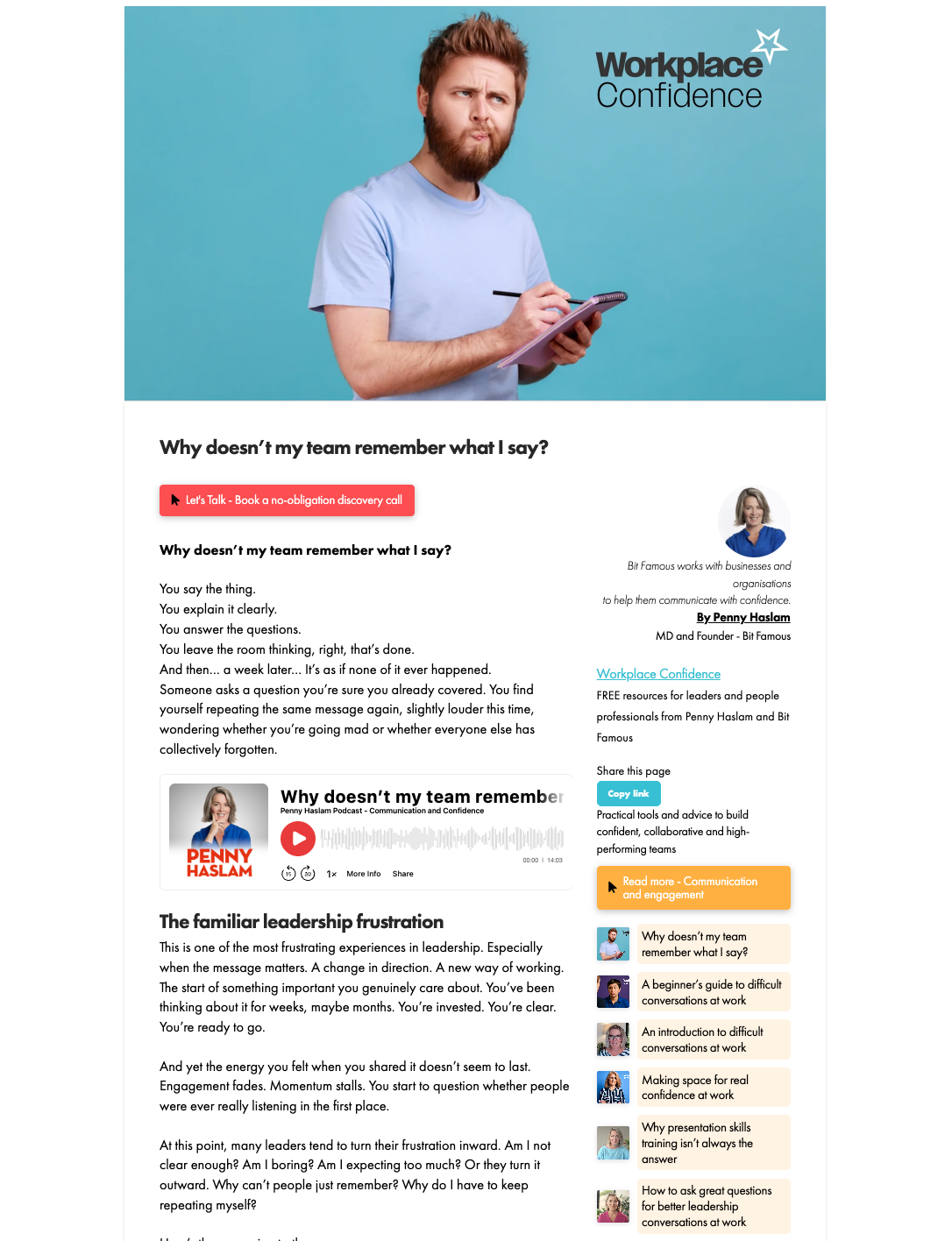
This page helps a visitor decide whether the episode is for them. It gives search systems visible text to crawl and understand. It also makes the page more useful for people who cannot listen straight away, prefer to skim before committing or want to find a specific point from the episode.
That does not mean padding the page with text for it's own sake. The better aim is to add useful, relevant and sufficiently complete written content.
Enough to help someone understand the episode. Enough to answer the main questions. Enough to show why this page deserves to exist.
Why podcast transcripts matter for AI search
AI search has made this more important, not less.
Google now has AI features in Search, including AI Overviews and AI Mode. Google’s own guidance says the normal SEO foundations still matter for these features: pages should be crawlable, useful, internally linked and built around helpful content. It also says important content should be available in textual form.
That is the bit podcasters should pay attention to.
This does not mean you need to learn a new dark art called AI SEO. It means the basic job has become more important:
- Answer the main question clearly
- Use headings that match real audience questions and search intent
- Include first-hand experience
- Make the host and guest clear
- Publish useful written content people can actually read
- Keep each episode page focused on a distinct subject
A transcript helps because it turns the spoken episode into visible text. It gives search engines and AI systems more material to understand.
But a raw transcript is not the finished job.
Automated transcripts can be messy. Names get mangled. Specialist terms come out wrong. Sentences ramble because spoken conversation does not behave like written copy. Anyone who has read an untouched transcript knows the feeling: somewhere between this is useful and why do I apparently speak like a dropped box of fridge magnets?
So yes, transcribe your podcast. But use the transcript as raw material.
Edit it, structure it and build a useful episode page around it. That is what gives the episode a better chance of being understood, found and listened to.
4. Your podcast needs its own website
Why the webpage provided by your podcast host is often not enough
Most podcast hosts give you some kind of web page for your show.
That sounds useful, and sometimes it is. If you only need a basic page with a player, episode list and subscription links, it may do the job.
But if you want to grow your audience through search, the free page provided by your podcast host is often not enough.
The issue is control.
Can you control the page title? Can you edit the URL? Can you add a proper introduction, useful headings, an edited transcript, guest details, internal links, images and a clear next step? Can you see what visitors do on the page? Can you shape the journey from “I found this episode” to “I listened, read more and took another action”?
If the answer is mostly no, the page is not really working hard enough.
This was one of the problems I noticed with My Garden Podcast. The host page was fine as a basic listing, but it did not give Google, or a potential listener, enough context. Episode titles appeared without much supporting text. The page had little room to explain what each episode was about. It also pushed people towards external listening platforms before they had settled into the show. You'll see the page for our show below on the Buzzsprout host. It's basically an invite for people to leave by clicking on Apple and Spotify podcasts. I recommend going into your podcast host settings and switching your free page to "Hide from search engines." It's time to do a better job building your own podcast website.
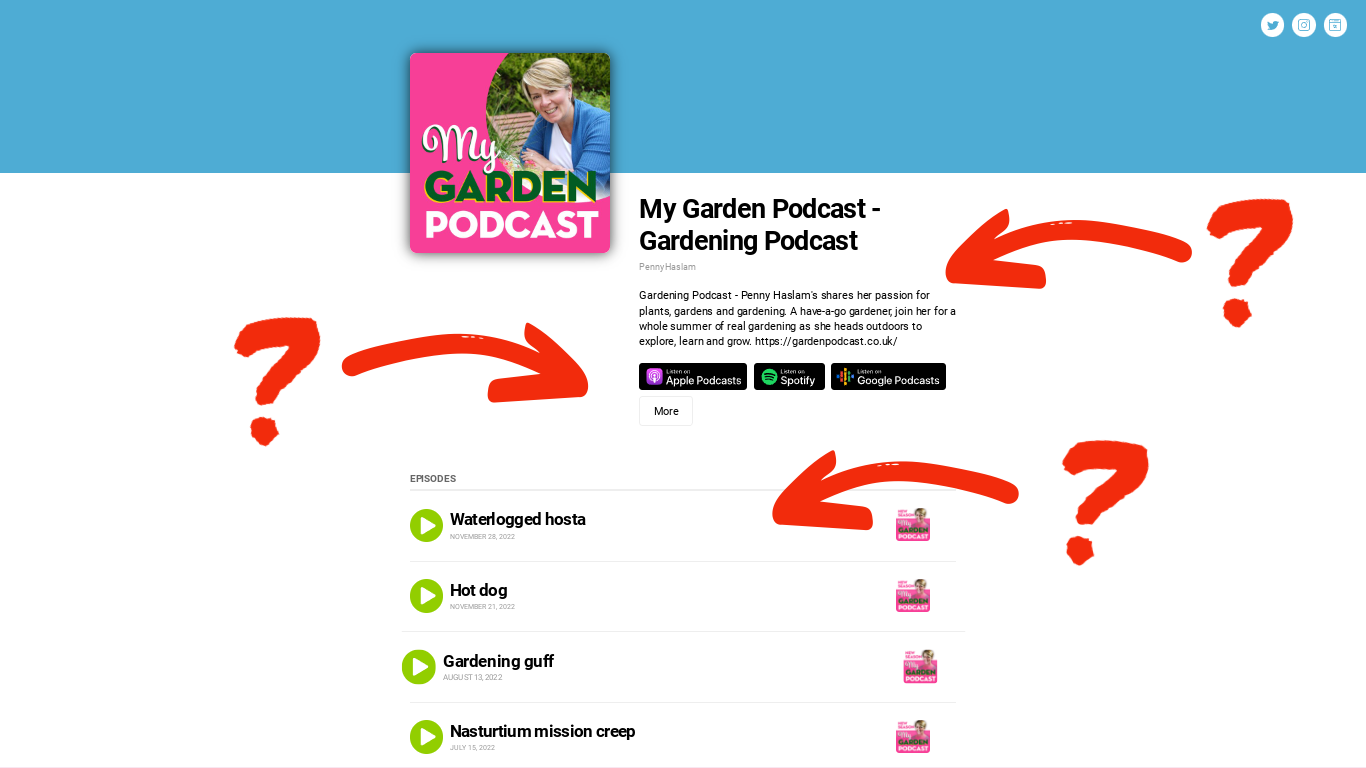
This is why I prefer a dedicated podcast website, or at least a proper podcast section on your existing website.
You do not need anything wildly complicated. You need a clear home for the show and one useful page (or post) for each episode. Treat it like a blog where each individual episode gets its own "post".
Keep listeners on your website
Here is where my thinking is a little counterintuitive.
Do not work hard to bring someone to your website, then immediately send them away with links to Spotify, Apple Podcasts or another platform.
Those links are usually added with good intentions. You want to make it easy for people to listen in their preferred app. Fair enough.
But think about what happens next.
You have managed to attract a potential listener. They are on your website. They are looking at your episode. They might listen, read, explore related content, join your mailing list, find out more about you or make an enquiry.
Then you offer them a big shiny exit door.
Once they leave for a podcast app, you lose control of the journey. They can browse other shows. They can get distracted. They can land in an interface designed by someone else, for someone else’s goals.
I have removed those prominent “listen on Spotify” and “listen on Apple Podcasts” links from my podcast websites and have seen listenership increase. That is not a scientific claim backed by a clipboard and white coat. It is my experience from working on my own shows.
The better approach is simple:
- Embed each episode with a player on its own post or page on your website
- Make listening on your website the primary action
- Keep the visitor on your site
- Give visitors a clear next step: link to related episodes and useful pages on your site only.
If someone already loves Spotify or Apple Podcasts, they can find you there. But your website should not behave like a polite traffic warden waving people away from where you actually want them to be.
What every podcast episode page needs
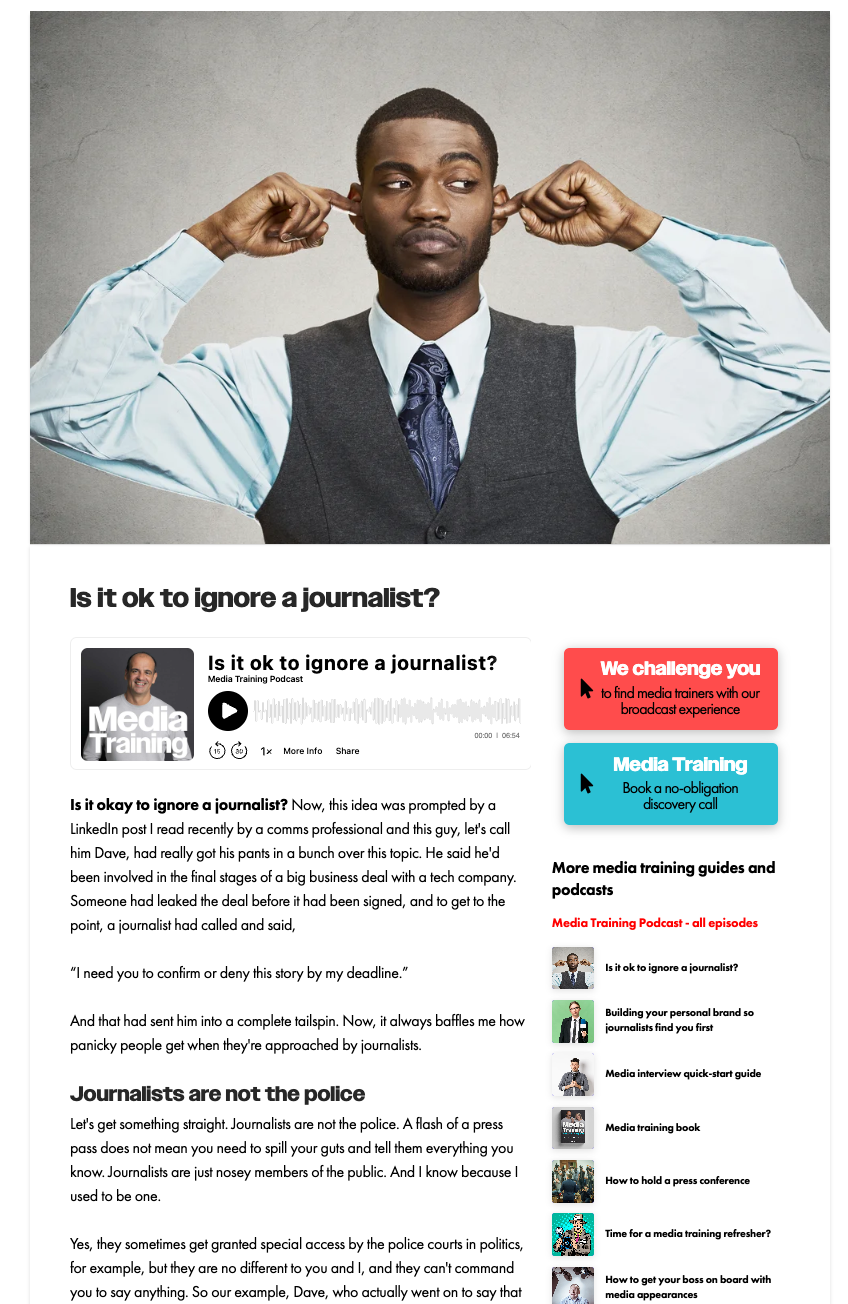
Take a look at this episode post from another of my shows called the Media Training Podcast.
This episode title is "Is it ok to ignore a journalist?" Note how that speaks directly to search intent for people with this issue. This is one of my most discovered episodes through search.
The title should help people understand the episode. The introduction should make the value obvious. The transcript should make the conversation readable and searchable. The links should help the visitor continue their journey without leaving the site.
The page has clear CTA's listen to another episode or book a discovery call or discover more about the media training services we offer.
I help knowledge-based businesses and organisations get strategic about their content, so their ideas are clearer, visible and more likely to generate the right enquiries.
Book a no-obligation discovery call
5. Find out what potential podcast listeners are searching for
What are podcast keywords and long-tail searches?
Keywords are the words and phrases people type into search engines.
That sounds more technical than it is. In practice, a keyword might be:
- Gardening podcast
- Is it ok to ignore a journalist?
- Best podcast for small business owners
- Confidence at work.
The keywords (or search terms) above are short, just a couple of words, this makes for a broad search. But, longer search terms are much more specific.
A broad keyword like “gardening” can mean almost anything. The person searching might want gardening tools, jobs, courses, ideas, books, shows, advice or a garden centre near them.
A longer search like “How to help leaders talk about the things that matter in a way that sounds clear, confident and human” tells you much more. This is called a long-tail search term. It is narrower and sharply focused on the intent and needs of the person doing the search.
These "long-tail" search tearms are much more specific phrases. They often have lower search volume, but they can be much more useful because the intent is clearer. Remember, you don't want to target everyone, just the people who need your specific topic right now.
You are not trying to win the whole internet for your podcast. You are trying to reach the people whose questions need answering right now with your topics.
How to find useful podcast search ideas that speak to your audience's needs
You probably already have more search ideas than you think.
Start with the language your listeners, clients, customers or guests already use. What questions come up again and again? What phrases do guests use when describing the subject? What problems does the episode solve?
Then widen the search.
Useful places to look include:
- Google autocomplete - Also, after a search, Google will often also display a list of "people searched for."
- Questions people ask in relevant communities, your own inbox, sales calls, comments and listener messages
- Google Search Console, if your site already gets traffic
- Google Keyword Planner - Find it in the tools of the free Google Ads app
- Answer the public
Google Keyword Planner is built for advertising campaigns, but you can also use it for research. It can help you discover keyword ideas and view search-volume estimates. Don't treat those estimates as perfect. Treat them as clues.
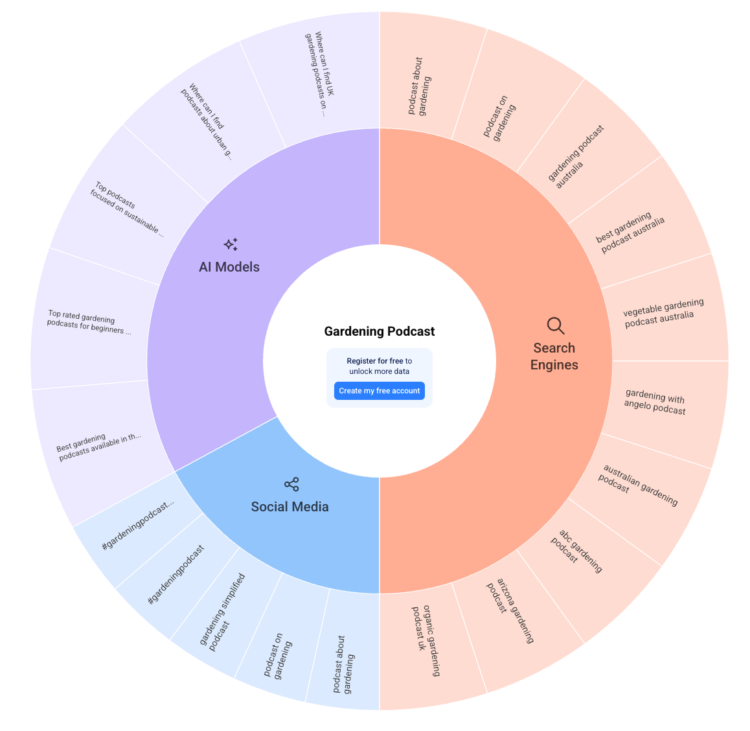
AnswerThePublic (below) can be useful because it shows questions and phrases around a topic that people are typing into Google. Again, do not treat it as an instruction manual. Use it to spot patterns in how people ask about your subject.
Choose one clear search subject for each episode page
Before I start a new podcast episode, I like to think about the main subject the episode should be known for.
Not the only phrase it will ever rank for. Not a robotic keyword to repeat until everyone involved loses the will to live.
Just the central search subject.
For the Penny Haslam Podcast, which focuses on confidence and communication, our business homepage is aimed broadly at confidence and communication skills at work. But Individual episode pages can then focus on more specific subjects using long-tail search terms including:
- The simple goal-setting tool that sets your team up for success
- How to speak in meetings with confidence and authority
- What is an example of negative self-talk?
The point is that each page should have a distinct job.
Warning! A common mistake is to repeat the same broad phrase across every page. You might think you are reinforcing the phrase, but you can end up making it harder for Google to understand which page is the best answer for a specific search.
It is better to avoid overlapping intent. So, to use my example, don't have ten episode pages on tomatoes.
If three pages all seem to answer the same question, they may compete with each other. If each page has a clear purpose, your site becomes easier to understand, find and easier to use.
Think of it this way: your podcast website is not one big pile of episode pages. It is a library. Each page needs a label that helps people find the right shelf.
6. How to transcribe your podcast and create a searchable episode page
Cheap and easy ways to transcribe a podcast
Transcribing a podcast used to feel like a slow, expensive job.
Now it is much easier. There are plenty of affordable tools that will create a transcript from an audio or video file. I have used Riverside, Adobe Podcast and Amazon AWS, but the exact tool matters less than the quality of the finished page.
You can use whatever transcription service suits your workflow, budget and level of patience.
The important thing is not to stop at the first automated transcript.
Think of the transcript as your starting point. It gets the spoken words onto the page. You still need to turn that raw material into something readable, accurate and useful.
Why you should not publish a raw transcript
Raw transcripts are useful. They are also often a bit of a mess.
Automated tools can get names wrong. They can misunderstand specialist terms. They can turn a guest’s carefully explained point into a sentence that looks as if it reversed into a hedge.
Before you publish a transcript, check it properly.
At minimum, look for:
- Names of people, places and organisations
- Product names, plant names, technical terms or industry phrases
- Punctuation that changes the meaning
- Missing or incorrect speaker labels
- Obvious transcription errors
- Repeated filler words that make the copy hard to read
- Broken sentences that need light editing
The aim is to keep the natural voice of the conversation while removing enough clutter for the transcript to be useful. When publishing a transcript, identify topic changes and add subheadings that speak to search terms and audience intent.
I help knowledge-based businesses and organisations get strategic about their content, so their ideas are clearer, visible and more likely to generate the right enquiries.
Book a no-obligation discovery call
7. Use your podcast show notes to link back to the episode page
Once you have found a long-tail search phrase that matches audience intent, created a proper episode page on your website and added the audio, transcript and supporting content, do not stop there.
Add a link to that specific page in your podcast show notes.
Your podcast show notes are the text, links and description attached to your audio or video file in your podcast host. Those notes are then distributed through your RSS feed to Spotify, Apple Podcasts and dozens other podcast apps and players across the web.
That makes the show notes a useful place to point people back to the page you control.
The important bit is to link to the specific episode page, not just your podcast homepage.
So if you have created a page for an episode answering a clear audience question, link directly to that page from the show notes for that episode. Use link text that reflects the listener’s intent.
For example, here's the podcast show note from my earlier example in the Media Training Podcast. See how it includes a link to my episode page. The anchor text is "Is it ok to ignore a journalist?" The same as the episode and post title. The url also matches the search term: https://marvellous.bitfamous.co.uk/is-it-ok-to-ignore-a-journalist/
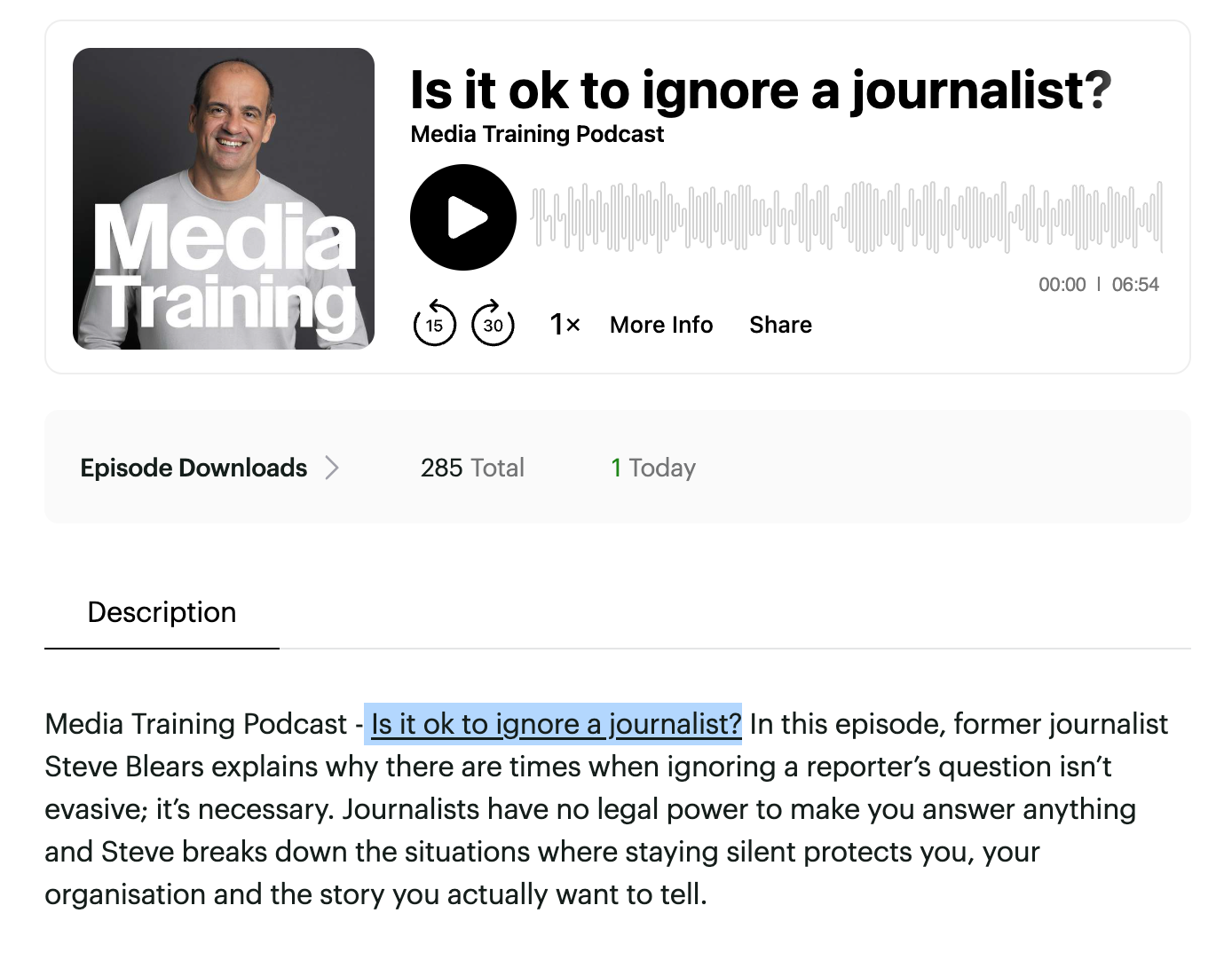
The link text and the URL should make sense to a person reading Them. It should describe the useful thing they will find when they click.
Backlinks build authority and PageRank
Google and AI bots will use backlinks, which links on the web pointing back to your website, as evidence of usefulness and authority.
Your show notes travel through your podcast feed and appear across different apps and players across the web. Not every platform will handle those links in exactly the same way, but it is still good SEO housekeeping and it supports the page you actually want people to find.
The mistake is linking every episode back to the homepage and hoping people work it out.
Be specific. If the episode answers a specific question, link to the specific page that answers it. That makes the episode easier to discover via your link being shared across the web.
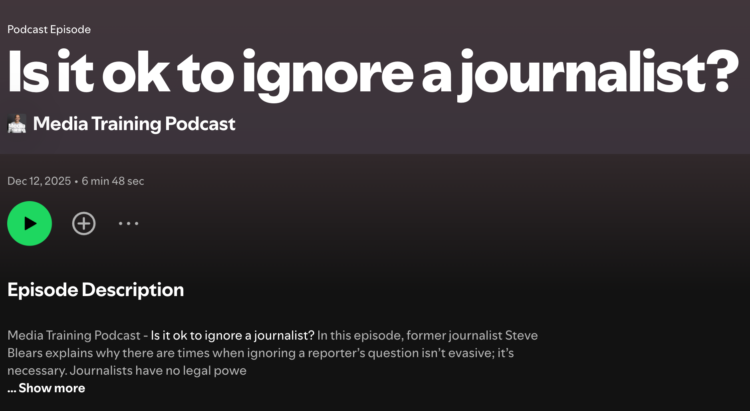
Look, here's the link back to my site showing up on Spotify! This is great for SEO.
Summary
A podcast does not have to sit around waiting for Apple, Spotify or a social media algorithm to notice it.
You can give each episode its own useful page. You can explain what it is about, publish an edited transcript and keep people on your own website, where they can listen, explore and take a sensible next step.
That is the real opportunity with podcast SEO.
It is not about tricks. It is not about stuffing keywords into every available gap. It is not about publishing a raw transcript and hoping the internet will be grateful.
It is about turning each episode into useful, searchable content.
Do that well and your podcast has more ways to be discovered. Not by everyone and not overnight, but by the right people when they are looking for the subject you cover.
I help knowledge-based businesses and organisations get strategic about their content, so their ideas are clearer, visible and more likely to generate the right enquiries.
Book a no-obligation discovery call