
Why will social proof like testimonials, case studies and awards help drive more leads and enquiries to my business?
Why will proof like testimonials, case studies and awards help drive more leads and enquiries to my business?
Because people don’t just buy what you do. They buy the confidence that you can do it well.
That’s the part many business websites miss. They explain their service, list their offer, and describe their process. But the buyer is looking for something else.
They want proof—evidence that you can deliver on your promises.
They want to know that other people have trusted you before. They want to see that clients have had a good experience. They want evidence that your work creates results, solves problems and does not leave everyone quietly regretting the decision by Thursday afternoon.
That is especially true for knowledge-led businesses.
If you are a consultant, coach, trainer, speaker, adviser, author or expert, your product is often your thinking, your experience, your judgement and your ability to help people make progress. That can be hugely valuable, but it can also feel intangible to a potential buyer.
They cannot pick it up.
They cannot test-drive it.
They cannot compare it to three slightly cheaper versions on a shelf.
So your website has to reduce the risk for them.
Testimonials, case studies, client logos, awards, reviews, recommendations and images of you doing the work all help do that. They show that you are not just making bold claims about yourself. Other people are willing to back you up.
And that matters because most people do not like making buying decisions on their own. They want to feel that others have already gone first.
There is safety in numbers.
If your website explains a lot but doesn’t show proof, buyers may see it as a gamble, not an opportunity.
Why does my website need social proof before people contact me?
Because your website is not just being read.
It is being judged.
Quietly. Quickly. Often unfairly.
A visitor lands on your site and immediately makes small judgments. Do you look credible? Do you understand their world? Have you worked with people like them? Does this feel like a real business or something patched together with enthusiasm and a Canva logo?
Harsh? Maybe. True? Absolutely.
Most website visitors won’t contact you right away—they’re still weighing things up, whether they found you through a blog, LinkedIn, a referral, or a late-night Google search.
At that stage, they are not looking for a sales pitch.
They are looking for reassurance.
That is where social proof earns its keep. It gives people small moments of confirmation as they navigate your site. A testimonial beside a service description. A client logo near a call to action. A short case study that shows you understand a problem they recognise. An award badge that says someone outside your business has taken you seriously.
None of these things has to do all the work on its own.
But together, they create a sense of safety: this business looks safe to talk to.
And that is often the first step. Not buying. Not booking. Not signing a proposal.
Just feeling safe enough to make an enquiry.
For knowledge-led businesses, making the next step feel low risk is crucial. Since you’re selling expertise—something intangible—buyers want confidence they won’t make a mistake.
Social proof does that by answering the question your visitor may never say out loud:
“Will I look sensible if I get in touch with these people?”
If the answer feels like yes, you have a much better chance of turning a quiet visitor into a real conversation.
What proof should I put on my website to make people trust my business?
Start with the proof that helps a buyer understand three things:
You have done this before.
You have done it for people like them.
You have created a result worth talking about.
That proof can come in different forms. You do not need every possible trust signal on day one, but you do need enough for a visitor to see that your business has substance behind it.
Here are the main ones to consider.
Testimonials
Good testimonials are the obvious starting point. But not the limp, one-line kind that says, “Great to work with!”
The better ones explain what problem the client had, what you helped with and what changed afterwards. That makes the testimonial useful, not just flattering.
Case studies
Case studies give you more room to tell the story properly. They let you show the challenge, the work, the outcome and the client’s view of what changed.
For knowledge-led businesses, this is gold. You can show how your thinking works in practice.
Client logos
Client logos work because they create fast recognition. A visitor can quickly see the types of people, businesses or organisations that already trust you.
The key is to be selective and genuine. Use only logos that reflect your business’s current direction, not every logo you’ve come across since 2009.
Awards and nominations
Awards, shortlistings and finalist badges can all help your website feel more credible. They show that someone outside your own business has looked at your work and decided it has merit.
That external validation matters.
Photos of you doing the work
If you sell expertise, show it in action.
Speaking at an event. Running a workshop. Chairing a panel. Coaching a group. Working with a room full of people who look like they are awake and not just waiting for sandwiches.
These images help visitors picture you doing the thing they might be about to book you for.
Reviews and recommendations
Google reviews, LinkedIn recommendations and comments on other platforms all add weight. They are useful because they do not only sit on your own website, where you control everything.
They show that people are willing to say good things about you elsewhere too.
The best website proof isn't a single thing. It is a mix of evidence that helps a potential client think, “Yes, this looks credible. They know what they’re doing.”
How did Bit Famous make one strong case study work harder?
One of our strongest examples came from work we did with Shawbrook Bank.
They asked us to support a group of women in leadership who they wanted to see progress further in the business. There was a clear people issue behind the work: if those women did not develop, move up or stay, the bank risked losing valuable talent from its leadership pipeline.
The results gave us strong evidence to work with. Within two years, all of the women had been promoted. Shawbrook also told us the programme delivered a 10x return on investment because it helped them retain and develop people, rather than spend heavily recruiting externally for those roles.
That one client story then worked hard in several places.
We used it:
1. On our website to show the impact of our work
2. In sales conversations to explain the commercial value of confidence and communication development
3. In proposals to help new clients understand what similar work could achieve
4. In an awards application, supported by the client comments, promotion data and ROI
That awards application helped us become finalists in the Personnel Today Awards, Learning and Development Supplier of the Year category in 2024.
Then the award shortlisting became another proof point in its own right.
So one piece of client evidence became a case study, a website asset, a proposal example, a sales story, an award entry and an award finalist badge.
That is the useful bit.
Do not collect testimonials and case studies so they can sit in a folder called “nice things people said”.
Use them. One strong client story can keep working across your website, marketing, proposals and sales conversations long after the project has finished.
Where should I put testimonials and social proof on my website?
Put your proof where people are making decisions.
That sounds obvious, but lots of websites treat social proof like a dusty side cupboard. There is a testimonials page somewhere in the navigation, usually between “About” and “Contact”, and everyone hopes visitors will make a special trip to read it.
They probably won’t.
You should still have a testimonials page. It can be useful. But your best proof needs to appear across the site, especially in the places where someone is deciding whether to keep reading, click, enquire or quietly disappear forever.
Start with the top of your homepage.
That first visible section matters because visitors make quick judgements. If you have worked with impressive clients, won awards or helped people get clear results, don’t hide that halfway down the page like a Victorian family secret.
Show it early.
Then add relevant proof to your service pages. If someone is reading about your leadership coaching, show them a leadership coaching testimonial. If they are reading about your speaking work, show them a quote from an event organiser. If they are exploring your consultancy offer, show them a case study that reflects that kind of problem.
Relevance matters more than volume.
A general testimonial is useful. A specific testimonial at the exact moment someone is considering that service is much stronger.
You can also place proof near your calls to action. If you ask someone to book a call, download a guide or make an enquiry, give them a final nudge of reassurance nearby.
And remember this: your homepage is not the only front door.
People might land on a blog post from Google. They might arrive on a case study from LinkedIn. They might find a service page through a very specific search. So do not save all your evidence for the homepage and assume everyone will politely start there.
They won’t. People browse unpredictably—that’s just how the internet works.
Spread your proof across your site so wherever someone arrives, they can quickly see that your business is credible, trusted and worth talking to.
What makes a good testimonial for a business website?
A good testimonial does more than say you were nice to work with.
Nice is good, obviously. Nobody wants to hire someone who brings the emotional energy of a wet Tuesday.
But nice is not enough.
A strong testimonial helps your future client understand the value of your work. It gives them something specific to believe. It points to a problem, a change or a result.
So, instead of chasing praise, ask for detail.
A useful testimonial might explain:
1. What was happening before the client worked with you
2. Why they needed help
3. What the experience of working with you was like
4. What changed afterwards
5. What result, improvement or business benefit they saw
That matters because vague praise is easy to skim past. Specific proof makes people stop and think, “That sounds like us.”
For example, there is a big difference between:
“Steve was great to work with.”
And:
“Steve helped us turn a vague service page into content that spoke directly to the problems our clients were already searching for. Within a few months, we were getting better quality enquiries from organisations that understood what we did before the first call.”
One is pleasant.
The other is useful.
Where possible, include the person’s full name, job title, organisation and a photo. That gives the testimonial weight. Anonymous testimonials are easy to assume they are made up, named testimonials are credible. If someone loved working with your why wouldn’t they put their name to it?
Also, don’t squash your best testimonials into tiny quotes AND NEVER TURN THEM INTO GRAPHICS which are invisible to search. Don’t embed them in code to create scrolling graphics. Use proper headings and titles. Pull out the key result. Let the words do their job. Show the sentiment for your business.
Why social proof turns website visitors into enquiries
Your website does not just need to explain what you do.
It needs to make people feel safe enough to enquire.
Proof matters because buyers are choosing expertise and trust. Display testimonials, case studies, awards, and reviews where people will see them—don’t hide your best evidence on a forgotten page.
Put proof where people make decisions: your homepage, service pages, case studies and calls to action.
Your website does not need to shout.
It needs to reassure.
I help knowledge-based businesses and organisations get strategic about their content, so their ideas are clearer, visible and more likely to generate the right enquiries.
Book a no-obligation discovery call

I help knowledge-based businesses and organisations get strategic about their content, so their ideas are clearer, visible and more likely to generate the right enquiries.
Book a no-obligation discovery call
Read next!

How to gather client testimonials that prove ROI and commercial value
Aug / 2026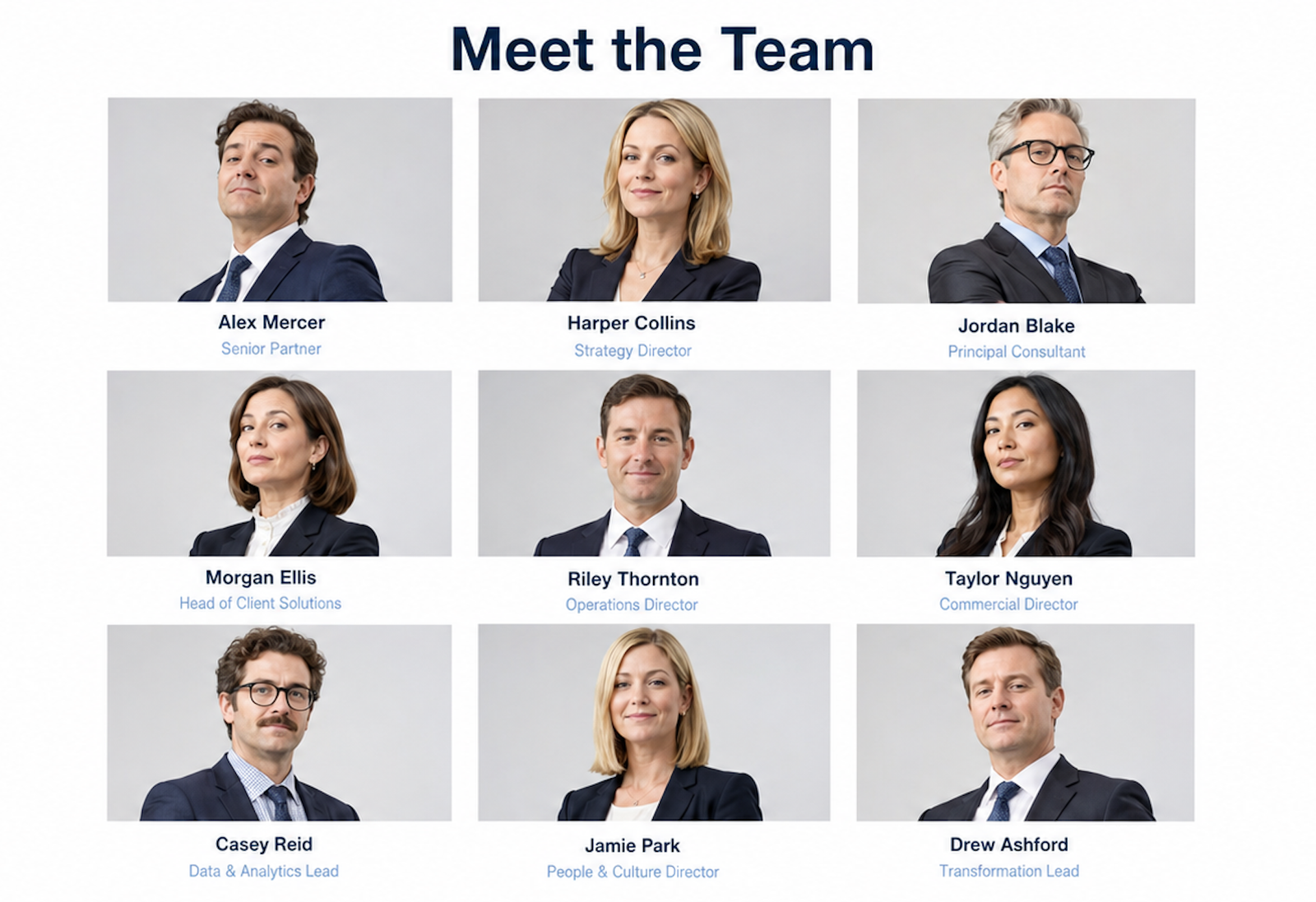
Are meet the team pages pointless? I’d rather meet their expertise
Jul / 2026
Why doesn’t my consultancy website generate business leads? 10 common mistakes
Jul / 2026
How to grow your podcast audience with SEO and expert content so people find you on Google and AI
Jul / 2026
How do I stop guessing what to blog about and choose topics based on customer intent?
May / 2026
Why do potential customers read my blog but not contact me?
May / 2026
Should I use Substack for my business blog? Why it could be a terrible idea for consultants, executive coaches, speakers and business authors
May / 2026Why will social proof like testimonials, case studies and awards help drive more leads and enquiries to my business?
May / 2026